|
||||
|
|
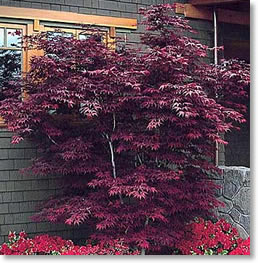
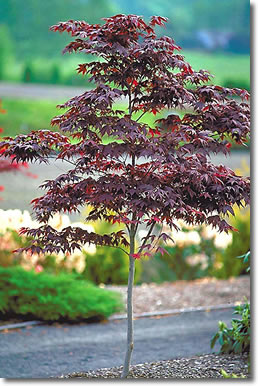
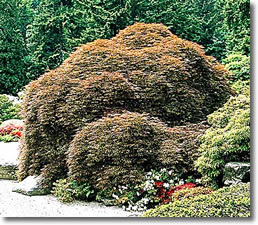
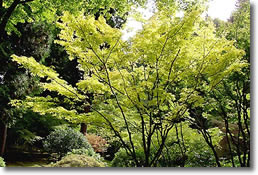
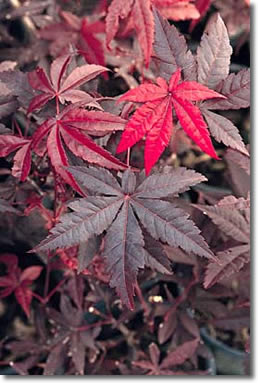
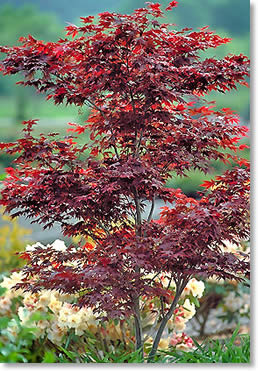
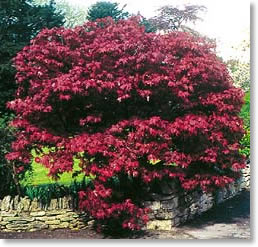
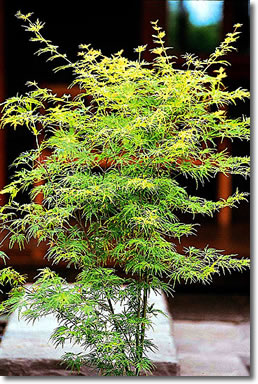
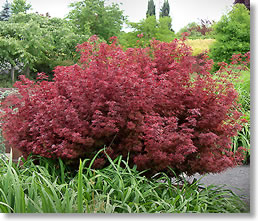
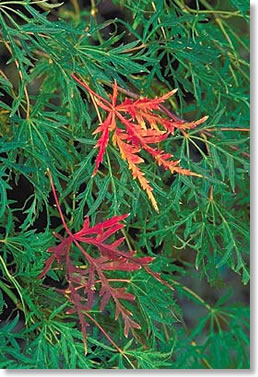
JAPANESE MAPLE Japanese maple (Acer palmatum): A deciduous, small to medium size tree appreciated for its cut leaves and upright, fine textured, compact to willowy spreading form. It can take considerable shade, although red-leaved varieties may lose color if planted in too much shade, and is one of the best small trees for narrow side yards or as a central feature in a woodland setting. The bark and leaves contrast well with walls or fences, whether leafing out in spring, in full summer foliage, or turning color in fall. Japanese maples do well in very large or small containers, and look good in a wide range of colors or materials. They only ask for not too much heat (especially reflected) and regular watering. The winter form is interesting, and it combines well with either formal architectural designs or informal, woodsy plantings. The green maple can be grown in full sun if it is supplied with plenty of high quality water, good drainage and acid planting mix. Grown in full sun the green maple will develop a more compact form. It is probably at its best in either part sun or mostly shade where its branches tend to be long, willowy, and with little taper. Frost hardy. Native to Korea, China, Japan.
Japanese maples are normally cultivars of Acer palmatum and Acer japonicum (Full Moon maple). In Japanese, the Japanese maple is "Momiji" or "Kaede" - baby hand or frog hand. Japanese maples are a favorite in the garden, with many cultivars available. Blue Hills usually has a good selection of varieties that do well in Southern California, if proper care in site selection and good horticultural practice are followed. Cultivars are divided into eight groups by Vertrees (a maple expert): palmate, dissectum, deeply divided, linearilobum, dwarf, semi-dwarf, variegated, unusuals. But for the sake of the average gardener, at Blue Hills we normally divide maples into green or red groups and then consider whether a palmate or dissected leaved tree makes sense for the given application. Blue Hills carries the following species and others: Black Japanese maple (Acer palmatum 'Nigrum')
Coral Bark Japanese maple (Acer palmatum 'Sangokaku') Crimson Queen Japanese maple (Acer palmatum Var. Dissectum 'Crimson Queen')
Emperor I® Japanese maple (Acer palmatum 'Wolff') Oshio-Beni Japanese maple (Acer palmatum 'Oshio-Beni') Red-Leaf Japanese maple (Acer palmatum 'Atropurpureum') Seiryu Japanese maple (Acer palmatum 'Seiryu') Shaina Japanese maple (Acer palmatum 'Shaina') Waterfall Landscape use: specimen small tree, maple glade, varieties available for the home and patio, containers; rock garden, companions with azaleas and camellias and other part-shade lovers, high canopy tree plantings, etc. Locating the Japanese maple in your garden: Think sunlight first. Part shade best but some cultivars do quite well in almost full sun in Southern California (straight species, green palmate cultivars, some red palmate cultivars). Dissectums and heavily divided cultivars need protection from western sun and drying winds. Variegated forms generally need additional protection - again depending on the cultivar's degree of variegation. Think drainage second. Generally prefer wide well-drained berms. Tolerant of sands to clays; generally prefers slightly acidic soils. Performs best under a good mulch of peat moss. Plant with a good acid planting mix such as Gardner & Bloome Acid Planting Mix. References: Japanese maples by Vertrees, Timber Press, 1987; Maples of the World by V.M. van Gelderen, Jong, and Oterdoom, Timber Press, 1994; Maples for Gardens by C.J. van Gelderen and D.M. van Gelderen, Timber Press, 1999. |
|||